

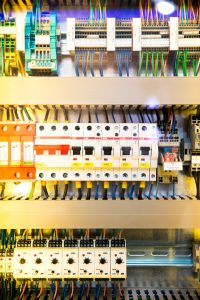
At IEW, we provide a wide range of circuit protection products from brands including First Power & Surge Protection. We deliver everything from small consumer units for domestic environments, to large distribution boards for industrial premises. We also keep all the remedial for all ongoing projects and more complex installations.
Here we’re going to talk about the different types of surge protection, and why it’s important to maintain it.
Lightning and surge protection.
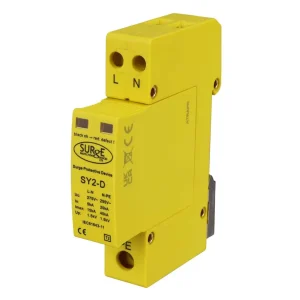
The FPSP Family of surge arresters includes a full range of compact protectors for installation on a DIN rail.
This range is specially designed to provide complete and effective protection against lightning strikes and critical surge events, protecting equipment and property connected to the low-voltage network.
The range includes Type 1 25 kA to 100 kA surge arresters in 10/350 µs waveform, and Type 2 surge arresters with different discharge capacities: 15 kA, 40 kA and 100 kA in waveform 8/20 µs. Type 3 SPDs of different discharge capacities are also available. The most suitable value will be selected according to the type of installation, premises and equipment to be protected (see the selection table). They are available in four different formats: one-pole, single-phase, two-phase and three-phase.
Photovoltaic & Windfarm
PV Inverter Protection
The inverter is the primary point in need of protection, a T1 lightning arrester is able to protect against a direct lightning impulse from the array and this should be coupled with T2 surge arresters for overvoltage, without this protection the entire system will be in jeopardy as the over current will continue to flow into the power network destroying the inverter other systems.
Ideally, an external strike point would be the best application, typically an ESE on the roof of the building and a T1 & T2 lightning and surge arrester on the inverter.
ESE Head
ESE Technology – Early Streaming Emission System.
NIMBUS is the most efficient and cost-effective protection system against lightning strikes in the world.
The Nimbus Lightning Rod with Early Streamer Emission (ESE) technology provides the most efficient protection against lightning strikes. It offers reduced installation costs and a reduction in the number of materials required for installation. (This system cannot be used in a BS EN design).
Equipped with the ESE technology, Nimbus lightning rods guarantee a greater protection area as well as improved security in the conduction of discharges down to earth in a controlled manner. A protection range of over 100m can be achieved with a single lightning rod. Cost and time saving installations are a key argument in favour of the usage of the Nimbus NFC 17102 compliant lightning rods.
NFC 17-102, IEC 61024-1, UNE-EN 50164-1, CTE SU 8, UNE 21186, UNE 21185
Why do you need a back up fuse upstream?
Due to their very nature, surge protective devices may achieve their end of life status (end of life cycle) after having been required to divert a severe overvoltage or a certain number of them. This is totally normal behaviour. When this happens, the built-in thermal switch of the CPT product will disconnect the device from the installation.
There is always a risk that a very severe overvoltage will cause the varistors to short-circuit. The associated fuse will then have to protect the installation by disconnecting the surge protective device from the network. If the nominal current of the general fuse is higher than a certain rated value (which will depend on the type and model of the surge protective device), it will be necessary to install an additional fuse, a back-up fuse, in order to assure correct protection.
Only a qualified electrician should install any power equipment, lightning or surge protection devices
Every CPT Protector is supplied with a product sheet that contains a comprehensive description of the installation procedure. The sheet is to be found within the same package as the product, or in the case of a pre-installed system it will be inside the enclosure.
Installation of the surge arrester is very simple for the power systems and even easier for the data units. Generally, the power protection devices are installed in parallel following a fuse selection and installation, the unit should be more than half a metre from the equipment to be protected.
All data protection devices are wired in series and these for the most part do not need an electrician to install them.
CPT products for combined protection against both transient and permanent (TOV) over voltages are usually connected parallel to the existing electrical installation, downstream of the MCCB and with earth connection. The V-CHECK 2D and V-CHECK 4D series do however not follow this rule as they have to be installed downstream of the RCD
.IEW have a FREE of charge massive selection of old breakers that fit various fuse boxes ( collected over the previous 10 years plus.)
Click here for our full range of circuit protection products.

If you have any questions or enquiries regarding circuit protection and distribution, please head to our Contact Page